Working remotely with clients worldwide
Third-Party API Integrations
Payments, bookings, messaging and other tools can become part of your website without making your team copy information by hand. I assess and implement documented third-party connections, with data mapping, credentials and failure handling included in the discussion.
Discuss your project
About Third-Party API Integrations
Third-party API integration for React, Next.js, Angular, PHP and WordPress websites. Payments, bookings, messaging and business-system connections.
Who this service is for
Businesses connecting a website or application to supported payment, booking, messaging, data or operational providers.
What the work can include
- Provider documentation and feasibility review
- Data mapping and server-side API connections
- Webhook handling where supported
- Timeout, duplicate and retry requirements
- Integration notes and agreed support scope
We agree on the deliverables, timeline and price before development starts.
Confirm provider capabilities
API access may depend on a paid plan, approval or region. We verify documentation and your account permissions before estimating. One available endpoint does not mean every feature can be integrated.
Keep private connections server-side
Private credentials belong in the appropriate backend configuration. We agree on which data needs to cross the connection instead of sending unnecessary information to an external service.
Handle repeats and failures
Webhooks can repeat and services can be unavailable. We define what can be retried, how duplicates are recognized and when someone should be notified, based on the workflow and provider behaviour.
My Third-Party API Integrations process
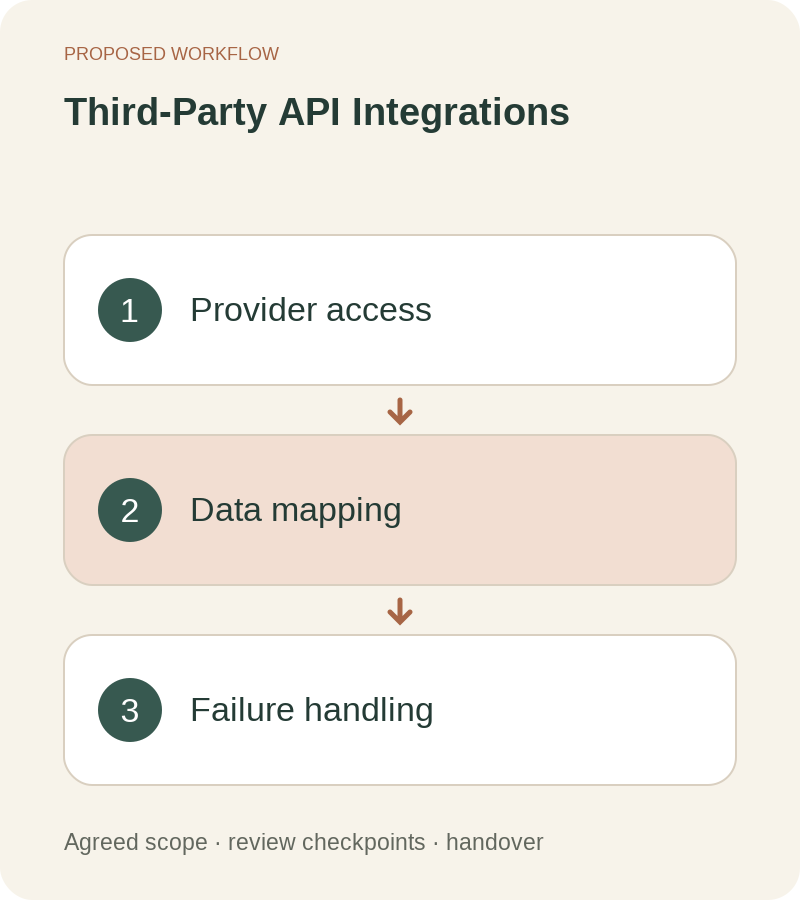
1. Plan the scope
Verify the provider’s documentation, account features and test access. Define the minimum data and actions needed for the connection.
2. Build and review
Implement mapping, private configuration and agreed error behaviour. Use supported test modes before enabling consequential actions.
3. Verify and hand over
Check success, timeout, duplicate and rejection scenarios. Document who maintains credentials and how failed deliveries are identified.
Benefits of Third-Party API Integrations
- Less manual transfer between the connected systems where the API supports it.
- Explicit ownership of provider accounts and integration configuration.
- A recovery plan for failed requests rather than silent data loss.
My approach
Feasibility comes before a promise. Paid plans, regional restrictions or approvals can limit an API even when documentation exists. I keep consequential actions within the agreed permissions and separate provider charges from development.
Portfolio evidence · separate from concept artwork
Project examples
There isn't a published case study for this specific service in my current portfolio. I won't present a concept illustration as completed client work. Send your requirements and we can discuss the approach and any relevant experience I can share.
Browse the full website portfolioWhy work with me on Third-Party API Integrations?
You work directly with Parvez, a developer based in Mumbai and available remotely worldwide. We agree on the scope, dependencies and review checkpoints before implementation. The approach above explains how I would handle this service; the work section identifies the evidence actually published.
Read about my background and working principlesFrequently asked questions
Can you integrate every API?
Not without assessing it. Documentation, account access and restrictions determine feasibility. I confirm these before committing.
Is this only for WordPress?
No. It can support React, Next.js, Angular and PHP sites too, with a suitable backend for private credentials and processing.
Who owns provider accounts?
Your business should control them and approve any subscription costs. We agree on development access and handover.
Can you assess an API before we buy a provider plan?
Yes, using available documentation. Some features can only be confirmed with test access or provider approval, so the assessment may identify conditions rather than guarantee availability.
How are webhook duplicates handled?
We agree on a stable event identifier and repeat behaviour supported by the provider. Repeated notifications should not blindly create duplicate business actions.
Can an integration retry when a provider is unavailable?
Where appropriate. We distinguish safe retries from actions that could repeat a payment or message, and define limits and escalation rather than retry indefinitely.
Will API keys appear in the browser?
Private keys should not be exposed in public frontend code. The implementation uses the appropriate server-side configuration and only the public credentials a provider expressly supports.
Can we replace an existing provider connection?
Yes, after mapping current behaviour and dependencies. We plan testing and cutover so the business knows which system receives events during the transition.
Who owns the third-party account?
Your business should retain control. Development access should be limited to the work required, and credential maintenance and provider billing need a named owner.
Can you integrate a provider without API documentation?
I cannot promise that. We should seek supported documentation or a vendor-approved connector; unsupported scraping or guessed private endpoints are not a reliable substitute.
Useful reading
Related services
Custom REST API Development
Custom REST API development for websites and applications worldwide. Endpoints, data contracts, validation and frontend connections by Parvez Khan.
View detailsWebsite & CRM Integrations
Website and CRM integration for clients worldwide. Lead capture, field mapping and sales workflows for PHP, React, Next.js, Angular and WordPress sites.
View detailsAI API & Application Integrations
AI API integration for React, Next.js, Angular, PHP and WordPress applications. Summaries, assisted drafting and knowledge features with scoped data access.
View detailsDiscuss your third-party api integrations requirements
Share the current setup, the problem you want to solve and any target timeline. We can review a practical next step without assuming you need a full rebuild.
Send your brief