Working remotely with clients worldwide
Ecommerce Website Development
Selling online involves the catalog, customer journey and team handling each order. I help plan and build ecommerce websites, from WooCommerce to a custom storefront connected to an existing backend. We choose the approach around the products and operations you need to support.
Discuss your project
About Ecommerce Website Development
Ecommerce website development for businesses worldwide. Product browsing, checkout, payments and operational integrations scoped by Parvez Khan.
Who this service is for
Retailers and businesses planning a storefront or improving checkout, catalog and order operations, with platform choice still open.
What the work can include
- Product, category and storefront layouts
- Cart and checkout journeys within scope
- Supported payment-provider integration
- Order, inventory or CRM connections where feasible
- Test purchases, failure states and launch handover
We agree on the deliverables, timeline and price before development starts.
Review catalog and fulfilment rules
Variations, stock, shipping regions and order handling change the implementation. We review these alongside the systems your team uses. Your business confirms its tax, payment and policy obligations.
Compare platform and custom options
A custom React or Next.js storefront adds flexibility and maintenance responsibilities. An established platform may already cover the workflow. We compare options before committing to architecture.
Test payments and orders
Testing includes failed and cancelled payments, not just a successful purchase. We define the test environment and expected order states with the provider and backend team before launch.
My Ecommerce Website Development process
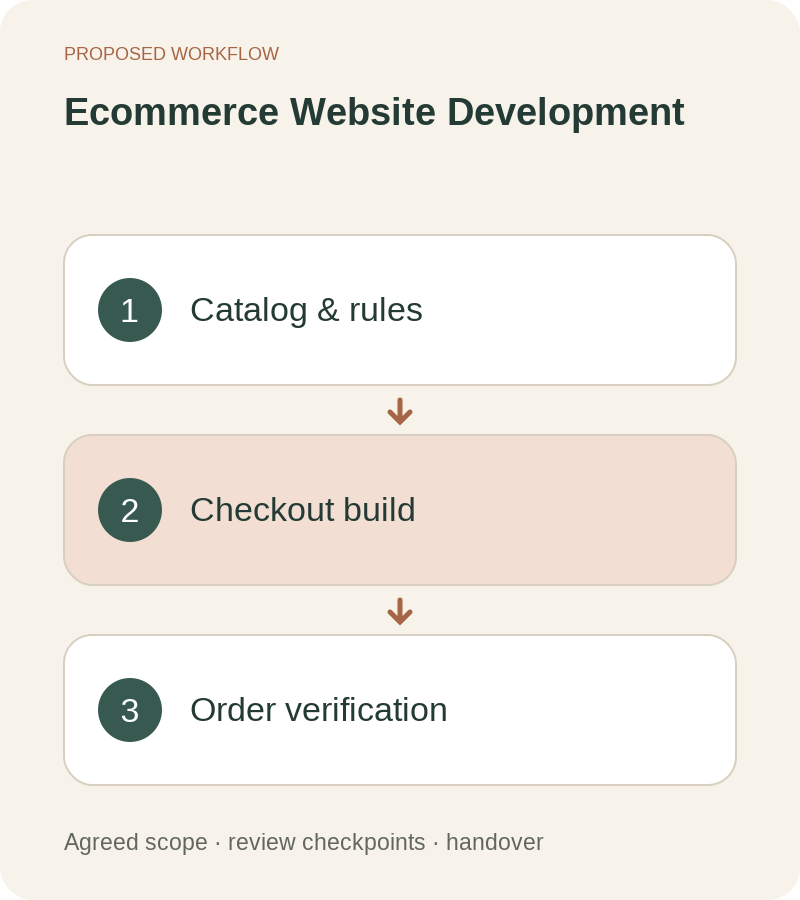
1. Plan the scope
Map products, variants, payment regions and fulfilment responsibilities. Compare platform features with the need for a custom storefront.
2. Build and review
Build the agreed catalog and purchase flow using test accounts. Confirm stock, delivery and payment-state behaviour with the business and provider.
3. Verify and hand over
Exercise successful, failed and cancelled orders. Hand over the operational workflow and clarify maintenance and provider costs.
Benefits of Ecommerce Website Development
- Platform decisions made from operational needs rather than appearance alone.
- A purchase journey connected to order handling.
- Explicit tests for payment failures and fulfilment exceptions.
My approach
An ecommerce project is a store operation as well as a frontend. I ask about inventory, fulfilment and provider restrictions early. Your business supplies tax and policy requirements; legal or accounting advice is outside development scope.
Portfolio evidence · separate from concept artwork
Related work I've completed
A WooCommerce online store from my portfolio. Open the project for its recorded description and screenshots.
Browse the full website portfolio
Why work with me on Ecommerce Website Development?
You work directly with Parvez, a developer based in Mumbai and available remotely worldwide. We agree on the scope, dependencies and review checkpoints before implementation. The approach above explains how I would handle this service; the work section identifies the evidence actually published.
Read about my background and working principlesFrequently asked questions
Is this limited to WooCommerce?
No. We can discuss a custom React or Next.js storefront and its commerce backend. Provider capabilities and scope determine the implementation.
Can you connect inventory systems?
I can assess documented APIs or connectors. We confirm the source of truth, synchronization and failure handling first.
Can the store sell internationally?
We can build for your supported markets. Payments, currencies, shipping and business obligations need confirming; worldwide availability is not automatic.
Can you help choose an ecommerce platform?
Yes. We compare catalog complexity, editing, payments, integrations and ongoing ownership. A custom storefront is not automatically preferable to an established platform.
Can a custom storefront use an existing commerce backend?
It can, if the backend exposes the needed supported APIs. Checkout, account and inventory capabilities should be confirmed before committing to the frontend.
Can you import an existing product catalog?
Import work can be scoped after reviewing the source data, variants and image rights. We agree on mappings and test a sample before a full migration.
How are payment failures tested?
We use supported provider test modes and agreed scenarios. Expected order states and customer feedback should be documented rather than guessed from one successful payment.
Will the store support international selling?
It can be planned around your approved markets. Payment eligibility, currencies, shipping and tax requirements need business and provider confirmation for those markets.
Can the store connect to stock or fulfilment tools?
Yes, subject to their API capabilities. We define ownership of stock values, update timing and what the team should do when a sync fails.
Are transaction fees included in your development price?
Provider fees, subscriptions and ongoing operating costs are separate unless expressly included. The estimate identifies the dependencies needed for the proposed store.
Useful reading
Related services
WooCommerce Development
WooCommerce development for clients worldwide. Custom store features, checkout improvements and payment integrations by Parvez Khan.
View detailsThird-Party API Integrations
Third-party API integration for React, Next.js, Angular, PHP and WordPress websites. Payments, bookings, messaging and business-system connections.
View detailsWebsite Redesign & Revamp
Website redesign and revamp for businesses worldwide. Improve page structure, responsive layouts and editing while planning URLs, forms and a safe launch.
View detailsDiscuss your ecommerce website development requirements
Share the current setup, the problem you want to solve and any target timeline. We can review a practical next step without assuming you need a full rebuild.
Send your brief