Working remotely with clients worldwide
Headless WordPress Development
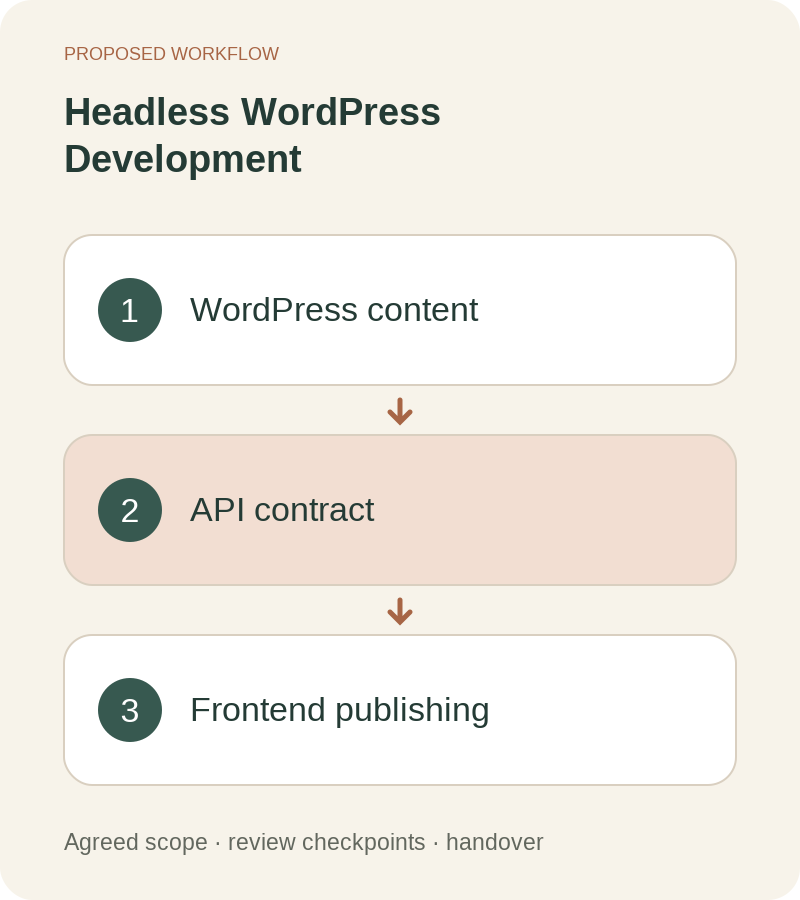
Keep WordPress for your editors while a React or Next.js application presents the content. I help teams define the content model, API contract and publishing workflow, either alongside your frontend developers or within an agreed end-to-end scope. We first check whether a separate application solves a real requirement and who will maintain both parts.
Discuss your project
About Headless WordPress Development
Headless WordPress development with React and Next.js. Content APIs, preview workflows and frontend integration for clients worldwide.
Who this service is for
Content teams and frontend developers who need WordPress editing with a separately maintained React or Next.js frontend and a clear API contract.
What the work can include
- Agreed content models, fields and representative API responses
- WordPress REST endpoints with documented access rules
- React or Next.js integration, or a defined handover to your frontend team
- Editor preview and publish-to-live acceptance checks
- URL, metadata, form and deployment responsibilities agreed before migration
We agree on the deliverables, timeline and price before development starts.
Choose headless for a reason
A separate front end is not automatically the best option for a business website. We'll look at the features, editor needs and ongoing maintenance before choosing the architecture. A traditional WordPress build may be simpler when the requirements allow it.
Agree on the content contract
Front-end developers need predictable data. In my work at Healthus.ai, I have built structured WordPress APIs for healthcare content used by React and Next.js applications. I bring that same attention to fields, response shapes and access rules when discussing a new project.
Include the editor and deployment workflow
Previews, redirects, metadata and publishing need a plan when WordPress no longer renders the public pages. We'll identify who owns each part and how changes reach the live website.
Prove one complete publishing journey
Before expanding to every template, agree on a representative page: an editor changes its content, previews it privately, publishes it and checks the public result. We also review a missing page and a failed content request. This gives your team concrete acceptance checks for the API and frontend instead of reviewing screenshots alone.
What to send for a useful scope
Share the current website, frontend framework and version, example content types, essential plugins and who maintains hosting. Describe how editors preview work and how quickly a published change must appear. Include the migration deadline and any forms, search or account features that must keep working; credentials can be arranged separately through an agreed channel.
My Headless WordPress Development process
1. Plan the scope
Map content types, frontend routes and editorial tasks. Compare headless with a traditional theme and identify who owns each application.
2. Build and review
Build the agreed data contract and frontend connection. Include previews, metadata and publishing behaviour rather than treating them as automatic CMS features.
3. Verify and hand over
Check content parity, permissions, redirects and form journeys. Document deployment dependencies and how editors verify a published update.
Benefits of Headless WordPress Development
- Structured content that the frontend can consume consistently.
- A clear split of backend and frontend responsibilities.
- Editorial and release workflows included in the architecture decision.
My approach
I plan the extra moving parts before building them. Separating the frontend does not remove the need for WordPress updates, API access rules or content QA. The recorded Healthus.ai work is relevant employment evidence, not a promise that every headless build has the same scope.
Portfolio evidence · separate from concept artwork
Related work I've completed
Documented headless WordPress and Next.js work within my Healthus.ai employment.
Employment work · Healthus.ai
Legacy PHP to Next.js landing-page migration
Migrated a legacy system of 69 PHP landing pages (67 city-level, 2 country-level) to a Next.js architecture backed by WordPress.
Read the case studyEmployment work · Healthus.ai
Headless WordPress content API
Designed and built a custom REST API exposing structured healthcare content — doctors, treatments, conditions, locations, hubs, health assessments and editorial content — to React and Next.js front ends.
Read the case studyWhy work with me on Headless WordPress Development?
You work directly with Parvez, a developer based in Mumbai and available remotely worldwide. We agree on the scope, dependencies and review checkpoints before implementation. The approach above explains how I would handle this service; the work section identifies the evidence actually published.
Read about my background and working principlesFrequently asked questions
Can you join our frontend team?
Yes. I can work on the WordPress backend and API contract alongside your React or Next.js developers, with clear responsibilities for each part.
Will headless WordPress make our site faster?
It depends on the implementation. Hosting, caching, rendering, images and scripts still matter. We should choose the architecture for the requirements and measure performance on the finished build.
Can we migrate an existing site?
Yes. A migration needs an inventory of content, URLs, forms, metadata and tracking. That work should be included in the scope rather than treated as an afterthought.
What should our team verify before approving a headless build?
Agree on a representative content-to-page journey, including private preview, publication, metadata, images and error states. Assign an owner for the API, frontend, hosting and ongoing updates. We can then review the approach and estimate the remaining templates against that agreed scope.
Can editors preview unpublished headless content?
Yes, if preview access and frontend handling are included. A preview must use appropriate permissions rather than expose draft content through a public endpoint.
Do existing WordPress plugins work unchanged when headless?
Not always. Plugins that render frontend features may need an API-compatible approach or a separate frontend implementation; we review dependencies before migration.
Can headless WordPress use REST rather than GraphQL?
Yes. The choice depends on the content contract and team requirements. Neither approach removes the need for access rules, predictable responses and documentation.
Where do forms run in a headless website?
We define a supported receiving endpoint and frontend feedback. The form’s backend, spam handling and delivery destination need their own scope even if the content is in WordPress.
Can the frontend keep old WordPress URLs?
Often, yes. We inventory routes and agree on frontend equivalents or relevant redirects so the publishing split does not accidentally discard existing addresses.
How do we refresh the frontend after publishing?
We define a cache or build-refresh method the selected hosting supports, including who handles a failed refresh and how an editor verifies the public result.
Does a headless site need two maintenance plans?
It has at least two sets of responsibilities: the CMS/backend and the frontend deployment. They may be covered by one agreement, but neither should be assumed maintenance-free.
Useful reading
Related services
Next.js Website Development
Next.js website development for businesses worldwide. Marketing sites, CMS-connected pages, migrations and API integrations by Parvez Khan.
View detailsWordPress APIs & Integrations
WordPress REST API development and business integrations. Connect content, CRMs and payment services with help from Parvez Khan.
View detailsCustom REST API Development
Custom REST API development for websites and applications worldwide. Endpoints, data contracts, validation and frontend connections by Parvez Khan.
View detailsDiscuss your headless wordpress development requirements
Share the current setup, the problem you want to solve and any target timeline. We can review a practical next step without assuming you need a full rebuild.
Send your brief